

Affiliate disclosure: This guide may contain affiliate or commissionable links. If you buy through an eligible link, Maximum Health Benefits may earn a commission at no additional cost to you. Commercial relationships do not determine our conclusions.
How this guide was made: This is a formula- and specification-based editorial comparison, not a claim that our editors personally wear-tested every sunscreen. See How We Review Products for our selection, sourcing, disclosure, and update standards.
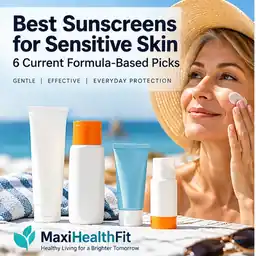
Sensitive skin does not have one universally “best” sunscreen. The most useful choice is a broad-spectrum SPF 30+ product that you can apply generously, tolerate consistently, and reapply when needed. Fragrance-free formulas and mineral filters can be helpful for some people, but no formula is guaranteed to be irritation-free.
Product lineups and manufacturer specifications were checked in October 2026; formulas can change, so confirm the current label before buying.
Our six current picks
1. Vanicream Facial Moisturizer Broad Spectrum SPF 30 — best minimalist daily mineral option
Vanicream positions this as a lightweight mineral facial moisturizer for sensitive skin. It uses non-nano zinc oxide, provides broad-spectrum SPF 30 protection, includes ceramides, and is non-comedogenic. The brand’s sensitive-skin line is built around avoiding common irritants.
Best fit: readers who want a simple daily moisturizer-plus-SPF and prefer a mineral formula.
Trade-off: SPF 30 meets the AAD minimum recommendation, but people who prefer a higher labeled SPF or a dedicated water-resistant outdoor sunscreen may want another option.
2. EltaMD UV Clear Broad-Spectrum SPF 46 — best for acne- or rosacea-prone sensitive skin
EltaMD UV Clear is an oil-free, fragrance-free, non-comedogenic face sunscreen designed for sensitive, rosacea-prone, and acne-prone skin. The current untinted formula contains 9% zinc oxide plus 7.5% octinoxate and 5% niacinamide. It is lightweight and available in tinted versions.
Best fit: sensitive skin that is also acne-prone or prone to visible redness/discoloration.
Trade-off: it is not labeled water resistant, so it is a daily-use choice rather than our first pick for swimming or heavy sweating.
3. CeraVe Invisible Mineral Sunscreen SPF 50 — best for readers prioritizing blendability
CeraVe’s Invisible Mineral Sunscreen SPF 50 is a mineral facial sunscreen intended for a wide range of skin types and tones, including sensitive and acne-prone skin. The formula includes ceramides, niacinamide, glycerin and panthenol, and the brand positions it as lightweight and designed to minimize visible white cast.
Best fit: people who want a mineral SPF 50 with barrier-support ingredients and are particularly concerned about visible residue.
Trade-off: “invisible” performance still depends on application amount, skin tone, facial hair and individual finish preferences.
4. CeraVe Hydrating Mineral Sunscreen Face Lotion SPF 50 — best barrier-support mineral formula
This 100% mineral face sunscreen uses zinc oxide and titanium dioxide and is formulated with ceramides, niacinamide and hyaluronic acid. CeraVe labels it suitable for sensitive skin; it is fragrance-free, oil-free and non-comedogenic, and it carries the National Eczema Association Seal of Acceptance.
Best fit: dry or sensitive skin that benefits from a more hydrating, barrier-supportive formula.
Trade-off: like many mineral sunscreens, it can leave visible residue on some skin tones despite careful application.
5. La Roche-Posay Anthelios Mineral Zinc Oxide Sunscreen SPF 50 — best matte water-resistant face pick
This 100% mineral facial sunscreen is fragrance-free, oil-free, non-comedogenic and formulated for sensitive skin. La Roche-Posay lists broad-spectrum SPF 50 protection and 40 minutes of water resistance, with a fast-absorbing matte finish.
Best fit: sensitive skin that prefers a mineral face sunscreen with some water resistance and a less dewy finish.
Trade-off: mineral finish and feel remain individual; a matte texture that suits one person may feel drying to another.
6. Neutrogena Sheer Zinc Dry-Touch Face Sunscreen SPF 50 — best for outdoor water resistance
Neutrogena’s Sheer Zinc face sunscreen uses 100% zinc oxide, is fragrance-free, hypoallergenic and non-comedogenic, and is labeled for sensitive skin. The manufacturer lists 80 minutes of water resistance.
Best fit: sensitive skin needing a mineral SPF 50 for more active outdoor use.
Trade-off: zinc-heavy formulas can feel denser or leave more visible cast than lighter hybrid sunscreens.
Quick comparison
| Product | Filters / SPF | Fragrance | Water resistance | Best use |
|---|---|---|---|---|
| Vanicream Facial Moisturizer SPF 30 | Mineral zinc oxide / SPF 30 | Fragrance-free positioning | Not our outdoor-first pick | Simple daily sensitive-skin routine |
| EltaMD UV Clear SPF 46 | Zinc oxide + octinoxate / SPF 46 | Fragrance-free | No | Acne/rosacea-prone sensitive skin |
| CeraVe Invisible Mineral SPF 50 | Mineral / SPF 50 | Check current label | Follow current label | Blendability + barrier support |
| CeraVe Hydrating Mineral SPF 50 | Zinc oxide + titanium dioxide / SPF 50 | Fragrance-free | Follow current label | Dry/sensitive skin |
| La Roche-Posay Anthelios Mineral Zinc SPF 50 | 100% mineral / SPF 50 | Fragrance-free | 40 minutes | Matte daily/outdoor face use |
| Neutrogena Sheer Zinc Face SPF 50 | 100% zinc oxide / SPF 50 | Fragrance-free | 80 minutes | Active outdoor use |
Check Current Product Details
Use the manufacturer pages below to confirm the current formula, active ingredients, SPF labeling, water-resistance claims, packaging, price, stock, and regional availability before buying. These are manufacturer-information links; they are not labeled as affiliate links unless a commercial relationship is separately verified.
- Vanicream Facial Moisturizer SPF 30
- EltaMD UV Clear SPF 46
- CeraVe Invisible Mineral SPF 50
- CeraVe Hydrating Mineral Sunscreen Face SPF 50
- La Roche-Posay Anthelios Mineral Zinc SPF 50
- Neutrogena Sheer Zinc Face SPF 50
How to choose sunscreen for sensitive skin
- Start with broad-spectrum SPF 30 or higher.
- Fragrance-free is often easier to tolerate. “Unscented” is not always the same as fragrance-free.
- Mineral is an option, not a requirement. Some sensitive-skin users prefer zinc oxide/titanium dioxide, while others tolerate modern hybrid or organic-filter formulas well.
- Match water resistance to use. Daily office use and a sweaty outdoor ride are different scenarios.
- Consider acne and rosacea separately. Non-comedogenic and oil-free labeling may matter more for acne-prone skin, while persistent rosacea symptoms deserve dermatology guidance.
- Use enough. A cosmetically elegant sunscreen used generously is more useful than a theoretically ideal formula applied too thinly.
What “sensitive skin” does not mean
Burning, itching, redness or stinging after skincare can reflect irritant dermatitis, allergy, eczema, rosacea or another skin condition. If reactions are frequent, severe or persistent, do not keep cycling through products indefinitely—consider professional evaluation.
Related Maximum Health guides
- Sunscreen Guide: SPF, Broad Spectrum, Application, and Reapplication
- Sensitive Skin: How to Choose Cleansers, Moisturizers, Sunscreen, and Serums
- Skincare: Build a Simple, Evidence-Based Routine
- Best Sunscreens for Mature Skin
Editorial sources
- Vanicream: sunscreens for sensitive skin
- EltaMD: UV Clear Broad Spectrum SPF 46
- CeraVe: Invisible Mineral Sunscreen SPF 50
- CeraVe: Hydrating Mineral Sunscreen Face Lotion SPF 50
- La Roche-Posay: Anthelios Mineral Zinc Oxide Sunscreen SPF 50
- Neutrogena: Sheer Zinc Face Sunscreen SPF 50
This article provides general skincare and product-selection information. It does not diagnose or treat eczema, rosacea, allergic contact dermatitis or another skin condition.


Pingback: Sensitive Skin: How To Choose Cleansers, Moisturizers, Sunscreen, And Serums - Maximum Health